

Censorship
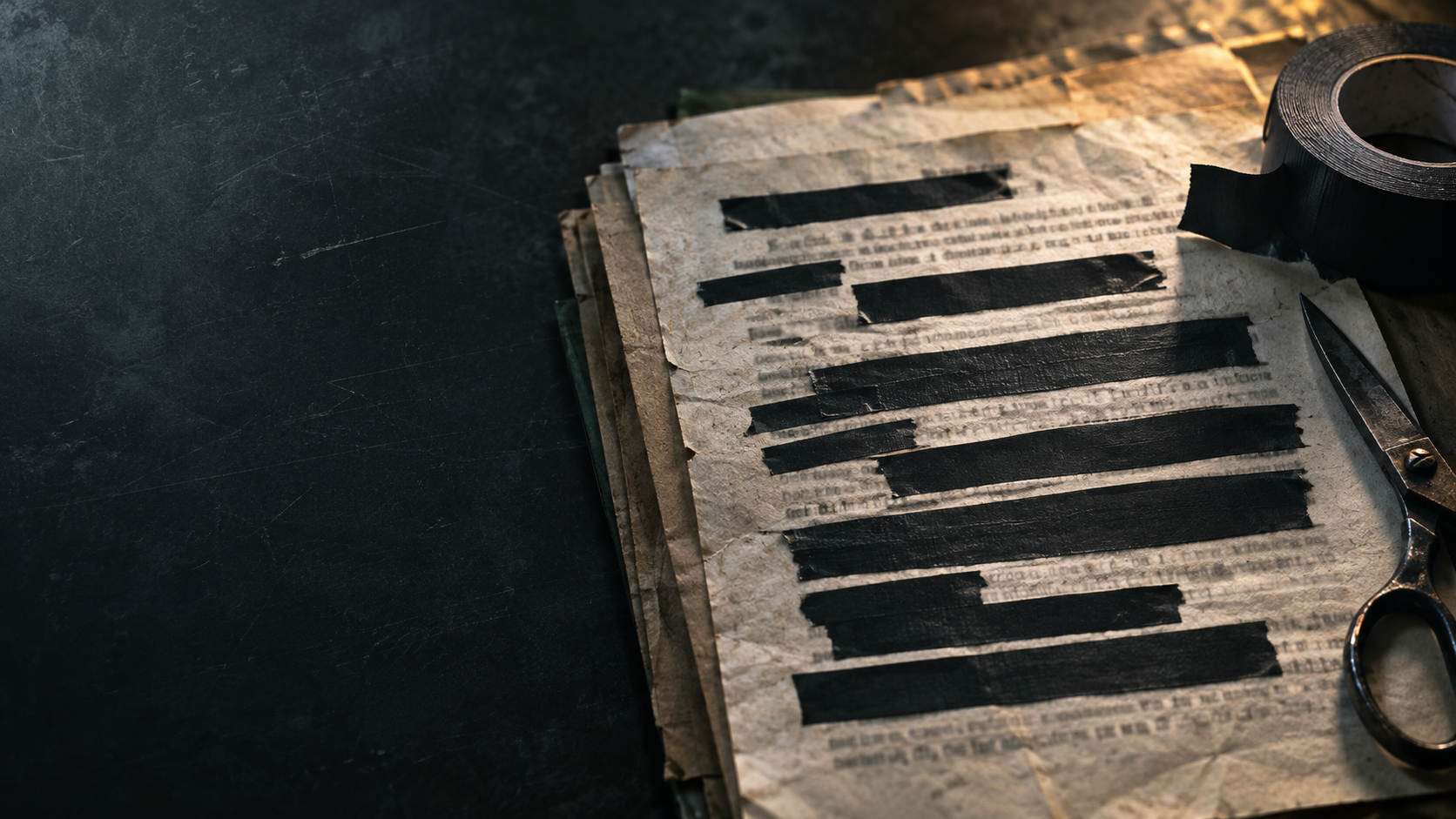
Today we are come to coming to the end of a littleseries called sacred cows. By sacred cows I'm talking about ideas that wegenerally hold to be above criticism. Is it possible that we could actuallytake some of these eyes these ideas and apply a sort of a lens to them, acritical lens to them, and think about them and perhaps think about them from abiblical point of view or put a Bible lens over them? So a couple of weeks agowe looked at multi multiculturalism, we talked about tolerance, last weekdemocracy, and today it's our last one I want us to talk about, I want us tothink about censorship. Well you might not have thought that that's what you'regoing to get when you were coming to church this morning, and if that's you I'msorry, and hopefully if this doesn't, you know, this is not what you wereexpecting, the rest of everything this morning will be great, right? The musicwill be lovely, the prayers will be edifying, you'll get morning tea servedfrom the wombat out the back, and it'll everything will be great. But that'swhat I want us to think about for just a few moments—I want us to think aboutcensorship.
What do we mean by censorship? A definition could go something like this:the suppression of speech or deletion of communicative material which may beconsidered objectionable, harmful, or sensitive, or perhaps this one: to forbidthe public distribution of matters deemed to be inappropriate for publicconsumption. So we are talking about things like literature and we're talkingabout public comment and perhaps film and TV and music and the things you readand the things you see and the things you listen to. So a couple of thingsabout censorship to start with:
There is a case for censorship. There are some forms of speech andexpression that are always harmful: vilification, vilification of people,racist slurs, defamation—they're all harmful, they all are all detestablethings. I have a friend who is making a living producing material online tohelp people who are struggling with their past and struggling with trauma intheir past, and she has shared a little of her story online on social mediathings and the various things that have helped her, and she's doing a good anda decent job, she's doing a good and decent thing. However she has beensubjected to the most horrible personal abuse from mostly men who thinkit's—I'm sorry—who think it's fine to make the most appalling comments abouther online. That's not freedom of speech, that is just simply vilifying, it'svile trolling. If you ever see it, you should call it out for what it is. Thereis a case for some things to be suppressed; that sort of talk needs to besuppressed.
And then there's the issue of privacy. There are some things that areprivate to me and they should stay private to me. So my medical records forexample, that's something that should be privately mine, that's something thatnot—that should not be shared to other people, that's something that is rightto censor. To censor that, I should be able to control those things that areprivate.
And then there's the issue of children. The protection of children is avery important thing in our society. In our country we have a legal definitionfor a child which is under 16 or a young person which is 17 to 18. It's afairly narrow definition, I guess you have to do that for laws—you, you people,many of you know that more than I do because this is the area you operate in.But we can't tolerate in our society the harm of children and young people. Welive in a fallen world and we need some wisdom about this, but we also needlaws—laws are going to help to some degree. And as many of you are morequalified in this area than I am professionally, you understand some of thecomplexities about this, but it's a good thing that we have laws. I'm glad wehave an office of the eSafety Commissioner. I am glad for the person whooccupies that role, Julian Grant, who speaks into that space and makes helpfulsuggestions, and her office. I have some friends who work in that office and Ithink it's a good thing that we have that. I'm glad we have an Office of Filmand Literature Classification that determines what should be rated G or PG or Mor MA15+ and tries to make some decision about what sorts of people are allowedto go into there by their age. When I had a 5-year-old daughter, I was morethan happy to censor what she watched, more than happy to limit her freedoms,even if it does mean I happen to have to listen to Julie Andrews sing "Thehills are alive with the sound of music" over and over and over again—andthat in fact was the sound that came out of the television room over and overagain for a very long period of time. But it's a good thing, isn't it?
Some books are not appropriate for children. To prevent children fromseeing what we might call adult entertainment is right. To prevent them fromseeing graphic violence is only right. It's hard to do because it's very easyto access, isn't it? It's just a click away. So restricting children's rightson social media, I'm supportive of that in principle—the prevention of harm forchildren, though it may be difficult in practice. So I'm supportive of allthose things.
But in general, I want to argue against censorship. In general, I want toargue against censorship. Censorship is a very dangerous and blunt instrumentbecause we can never be certain of the truth. If the people in power censorinformation, we can never be sure of what's true. All totalitarian regimes wantto censor communication in order to stay in power. When Leon Trotsky startedwriting polemics against Stalin, not only did Stalin have him bumped off in1940—he had him assassinated—but Stalin also tried to erase him from thehistorical record. And so you can see photographs, black and white photographsof Stalin with Trotsky, and then you can see other photographs—it's the samephotographs, but Trotsky's missing. Oh, there he is, now he's gone, becauseStalin had him or tried to have him removed. And that's all in the days beforeAI could do it so easily. Democratic governments and parties sometimes want todo the same so you'll vote for them. That's why it is so important that we havea free and independent media in this country and in western democracies. It'simportant to hear opposition, it's important to hear alternative arguments.
I want to suggest to you that censorship is bad because as the censor'spower grows, the victim is truth. And that passage that John read for us—Johnread for us in John chapter 7—I'm really going to refer to it just for a minuteor so, but it's really worth having a read and thinking through what Jesus isactually saying. It's a complex interchange he's having with the authorities.He says things like this in verse 32, he says: "You'll know the truth andthe truth will set you free.". That's an interesting idea—the truth isgoing to be something that sets people free. He says in verse 44—he says tothese authorities: "Your father is the devil.". He's not being allthat politically sensitive at that point, is he? "Your father is the deviland he has been a liar from the beginning. When he speaks—when he lies, hespeaks his native language.". And you might remember that very openingchapters of the Bible where they're in the garden and the devil says: "DidGod really say that you shouldn't eat the fruit from that tree? God knows ifyou eat it you're going to be just like him. He doesn't want you to be likehim. Eat it, it'll be fine.". So the suppression of the truth is the issuethat Jesus is speaking about here.
We might feel like we know the truth, but we can't know it reliably to betrue if we can't test it, and the only way we can test it is to hear a contraryview. Here's just a little aside to you: if you only listen to the views youagree with and you never listen to contrary views, you'll never know whetherwhat you're hearing is true. If you just listen to one point of view all thetime, one commentator, you need to be able to hear the critique of your viewand not just listen to it in order to kind of, you know, shoot things at it ortake pot shots at it or criticize it, but really listen—really listen to thebest points of the people who are saying something different to you. Try andoccupy the worldview of the person who's got a different view to yourself. It'sa good thing to do.
As a Christian believer, I find it tedious that in the media Christianpeople are often lampooned and mocked and misunderstood and often attacked inthe name of freedom of speech, but if that's the price of truth, bring it on!It's much better to live in that sort of society than another sort of society.I'd much rather live in a country where no critique is offered about—I'd ratherlive in this country than a country where there's no critique offered about thereligion at all, it's just not permitted to be said. Because if you're in acountry like that, you have no way of knowing whether you're right or wrongbecause no one can speak about the alternative. When you know there is nocensorship, you know nothing's been hidden from you—it's all there. See, I'mglad I can read whatever I want to read. When you read the work of the newatheists—well, they're kind of old atheists now, but they were the newatheists, people like Richard Dawkins when he writes his book The GodDelusion or The Selfish Gene, the popular bestsellers—when you knowyou can read it free and unadulterated, and if these are the best argumentsthat people can come up with against Christianity and you read them and yourealize they're pretty flimsy and pretty crummy really, then I need to readthem and I need to evaluate them, don't I? I can do that because I know it'sthere. But if the book is censored, if someone takes it off the shelves andwon't let me read it, there may be reasons or arguments I just don't knowabout.
See, what I'm arguing for is a society where we can have dissenting viewsand not have them censored. That's why I think the internet in principle is agood thing. It's true that it opens up the possibility of flooding us withdegrading material and vilification and toxic commentary and things like that,but as a Christian, I believe in the democratization of information, and at itsbest that's what it does—it provides me with this information democratically. Ican never get talkback radio hosts to find out my opinion, I can never getnewspaper columnists to ring me up and ask what I think, but Facebook—it'smine, except I've lost my password and I can't access it!
But there is a problem there as well, and the problem is the algorithm.The algorithm is a means by which social media takes what it thinks you want tosee and gives gives you more of it and more excessively. There is a terrificpodcast put out by The New York Times a few years ago called TheRabbit Hole—it's about an eight-part series, it's really worth listeningto, The Rabbit Hole, I'd encourage you to do it. It's an excellentproduction because what it does is tries to show just how this happened, andit's kind of dated because it's before AI, so you know now this is even writtenmore large than so. So there is a force, a mathematical algorithm that looks atwhat you search for and gives you more of it, so it is curating what you want,and it's a mathematical phenomenon. In the days of mass media, there used to bea human making these decisions or a group of humans. It was a group of humansin the Channel 9 newsroom who made the editorial decisions about what goes onthe news; it was the people in the ABC newsroom that decide what goes on theABC News—I mean, still, it's still the case. You knew that if Brian told methen it's okay 'cause I can trust Brian, Brian's not going to tell meanything—it's a human that is going to be making these calls. But here it's analgorithm, an elaborate computer program. And so for that reason, I would wantto say to you, you just need to be really discerning about what you imbibe. Ifyou use a browser that's produced by Google, for example, and I think, youknow, something like 70% of people do, it will be trying to tell you what itwants to tell you. And you might not have even noticed this, but about twoyears ago they rolled out the AI overview, so the very first thing you see isnot even, you know, what the particular first web page was, but it's what AIthinks is what you are thinking you want to see—it's highly filtered.
So to finish, what might the Bible say about this? I've just got a coupleof things to offer. Paul in Philippians 4:8 says this: "Whatever is true,whatever is honorable, just, pure, lovely, commendable, excellent,praiseworthy, set your minds on these things.". In other words, make achoice of what you want to subject yourself to. I think the Bible here istalking about self-censorship—what do you want to see, what do you want toread, what do you want to hear? You know, there are some things I just don't wantto put myself through; there are some things I just don't really want to watch.If I'm going to watch a film, I want to watch something that's going to do mesome good. I want to watch something that's beautiful or something that's goodfor me, maybe that's something make that makes me think—it might be pureescapism, but I want to make that decision, I want to choose, and I'll chooseto rule some things out. Titus chapter 2 verse 15—that was the verse for theday that Jeff mentioned at the beginning: "To the pure, all things arepure, but to the defiled, nothing is pure.".
In other words, I think what he's saying there is he said we always bringourselves to whatever we see or hear. We bring our own innocence, we bring ourown corruption to whatever we see, read, hear, whatever we experience—we bringsomething of ourselves to it, and we're all different. So we need to thinkabout what we subject ourselves to and what we subject others to as well. It'snot just enough for me to be free, I've also got to work out what's good foryou. I want to do what's good for you, not what is just free for me. Myfreedom, my freedom of expression, should not come at your expense. The Biblesays over all these principles, put on love. And I think that is that is theorganizing principle for the way we approach this particular matter. It's abouttruth, but it's about love as well—truth and love. Thank you.
Corinthians


Other Resources


Who we are
Jesus is at the centre of all we do—and has been since our first services in 1872! We believe that the beauty, goodness and truth of Jesus are the balm our broken world needs today.
Wherever you are on your journey, there’s a place for you at Christ Church Lavender Bay.


